
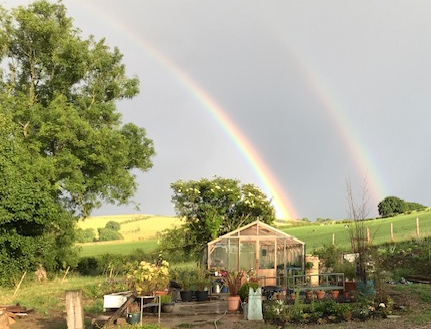
One of the questions that people often ask me is “Why am I so tired even when I rest?”. I thought I’d answer that question whilst also appreciating this fabulous photograph I took of a double rainbow over my greenhouse because today is #nationalfindarainbowday.
It’s true that rest is elusive for many of us. We seem to be in constant state of exhaustion. We sleep poorly, we have little capacity for stressors and we succumb to every illness that does the rounds as our immune systems are running on empty.
We find ourselves over-reacting and under-achieving and at the back of our minds we promise ourselves that things will be different once we get some rest. But, what has this got to do with rainbows?
Traditionally, rainbows bring promise of sunshine after the rain, of hope and of a better world, if we are only prepared to search over the rainbow. You see we’re not encouraged to stop and enjoy the rainbow. Instead, we’re brought up to chase whatever lies over the rainbow.
What would change if the moment we saw a rainbow we took it as a cue to stop? If we taught our children to pause and reconnect with something infinitely bigger than we are? What if we learnt to acknowledge that the beauty was in the moment and weren’t instantly distracted by what might over the rainbow?
My partner and I live very remotely in North Wales and one of the big takeaways from living here is how small we are in comparison to Mother Nature. This rainbow photograph always makes me smile because in our culture rainbows are associated with treasure if only we can find a way to reach the end. But, what if the magic is in the actual rainbow itself?
What if the inspiration comes from the alchemy of rain and sunshine in creating these wonderful arcs of colour? And what if the promise of treasure at the end of the rainbow is another diversion, typical of human beings, distracting us from the wonder of the here and now. What if the joy comes from stopping in the moment and appreciating the magnificence of the rainbow? Our children do this. In nursery or infant school miles of school walls are decorated with the joy and glory of magnificent rainbows. Colours are sourced, crescents are drawn as our little ones try to recreate the wonder that fills our skies after the showers. The crock of gold is often added as an afterthought, if it’s added at all; the star of the show is the rainbow itself. Isn’t it lovely to see a group of children immersed in drawing or colouring?
As adults though we bring complexity to the issue. The rainbow becomes a means to an end; the elusive crock of gold becomes the focus surpassing the wonderful architecture in the sky. Excitedly, we tell our children stories of what might be and all the time we lose sight of what is.
What is; is the beauty of the rainbow. What is; is the calm after the rain. What is; is the natural wonder that Mother Nature shows us reminding us that the world is still a beautiful place no matter what harm mankind imposes.
Just like the promises at the end of the rainbow, one of the treasures that often eludes my clients is rest. So many of us are tired. We get caught up not in climbing rainbows, certainly not in stopping to appreciate them but in being stuck on what often feels like a hamster wheel, endlessly circling without respite. The initial joy of climbing onto the wheel, of assuming a myriad of responsibilities is eclipsed by the monumental difficulty of climbing off once in a while.
So how do we slow the wheel long enough for us to stop and take rest so that we can add to our resilience stockpile? And how can stopping and appreciating rainbows help us live better and more resiliently?
Human beings are complex; we are also ambiguously simple creatures. We often take concepts like rest literally. If we’re not in motion, actively working, or achieving then it’s time for rest. Here’s where so many clients get stuck. They associate rest with passivity. We have phrases like “I’ll rest when I’m dead” which infer that rest is bad for us and yet rest is exactly the opposite. Rest is an opportunity to fill our resilience cups. If we don’t slow down on the forecourt, how can we fill our tanks?
In her book ‘The Seven Types of Rest’, Saundra Dalton-Smith shares the types of rest that build resilience and help us to live well. Seven ways to slow down and stall the hamster wheel. Seven ways that we as human beings can recalibrate and restore balance.
Firstly, comes physical rest; the stopping and the pausing that provide valuable opportunities for the mechanics of being human to slow down. Mental rest; taking opportunities to quiet an over engineered mind. Sensory rest; finding ways to reduce the stimulation that our brains were never designed to experience 24/7. Emotional rest; using opportunities to build natural authenticity so that we live without the wearisome masks that many of us feel compelled to assume. Social rest; taking time to surround ourselves with non-toxic people, or reducing the number of people in our lives, dependent on our personal needs. Creative rest; the human race is creative. Look at the design and build of the recent space launch, imagine that knowledge came from the minds of men but it’s often only in the pause that creativity has opportunity to spring forth. And finally spiritual rest; the opportunity to connect with something bigger than we are so that we take time to remember that being here is a privilege and at times requires moments of perspective.
This final point, spiritual rest, is the place where rainbows sit. It sits in the wonder of a world that still can leave us in awe when we allow ourselves the time to pause and rest.
The next time you ask yourself, “why am I so tired even though…”
- I went to bed early
- I had a clear weekend
- I’ve had a few days off…
just do a double check. How many types of rest did you engage in today? Did you prepare ahead for a good night’s sleep, or did you just come to a stop at the end of the day and expect your sleep programme to take over? Did you take opportunities to still your mind, rebuild your resilience levels, and allow your mind the possibility of pausing and doing nothing? Or did you blunder into sleep the way that many of us do?
Is it time to stop and fully appreciate the wonders that we still experience every day?
When I think of resilience, and especially how we build resilience, I often think of a prayer that I loved as a teenager, and it remains apt whether you believe in God, in Mother Nature, or instead in something greater than ourselves:
“come then apart unto the mountain and gather in the very breath of God to give thee life again.”
Wishing you all the colours of the rainbow and rest, plenty of rest!
Carol Hickson is a Therapist, Life Coach, Workplace Trainer, MHFA Instructor and a mental health and resilience Author. She builds mental health and wellbeing strategies for businesses, audits staff wellbeing, creates training programmes, coaches staff and shares best practice to mitigate psychosocial risk in the workplace.